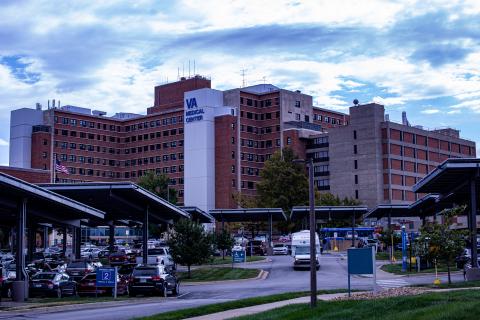
Optometry Residency Program
The KCVAMC Primary Care/Low Vision Optometry Residency program is looking for enthusiastic self starting individuals who enjoy learning in an exciting Medical Center environment. Three residents are selected each year. The program is affiliated with the UM-SL School of Optometry and was the first COE approved residency program in the United States. As of July 2006 the program has graduated more than 70 residents. These individuals have gone on to be VA staff, Optometry School faculty, Department of Ophthalmology faculty and participants in joint OD/MD practices all over the country.
Basic Information
Length of program
12 calendar months
Program Start/End
July 1 thru June 30th inclusive
Salary/Stipend
Approximately $30,000/year
Benefits
Health insurance (must get within 60 days of start of employment)
Professional liability insurance (Federal Tort Law
Sick leave/Annual leave
Authorized absence to attend professional meetings
Free parking
Expected weekly hours
Approx 40 hours in the clinic each week.
The resident is expected to spend additional time in self-study, writing papers, participation in or learning about research, etc.
Completion Acknowledgement
Certificate
Requirements for Completion
Completion of the 12 months of residency
Participation in advanced low vision rehabilitation seminars & lectures
Presentation of lectures to fourth year students & faculty
A minimum of one manuscript of publishable quality or Poster/Presentation/Lecture presented at a regional or national meeting or completion of a research project
Attend either the AAO or the HOA. May need to take the Advanced Competency in Medical Optometry Exam
Non-discrimination
The KCVAMC Optometry Residency Program provides equal educational opportunity regardless of race, color, creed, religion, national origin, sexual orientation, veteran status, age, or sex.
Staff
Joseph H. Maino, OD - Chief, Optometry
Tim Harkins, OD - Director, Residency Program
Kristen Jaloszinsky, OD - Chief, Victors Low Vision Rehabilitation Program
Optometry Residency Program Description
Education in Ocular Disease

Learning eye disease at the Kansas City VA Medical Center is an exciting mix of didactic education, self-study, and patient care. There are three steps to learning: learning the facts; organizing the facts; and applying the organization to help your patients. Optometry school does an exceptional job of teaching the facts. The Kansas City VAMC Optometry Residency program excels at helping you to organize the material so it makes sense, so you can recall it, and so you can take excellent care of your patients. (This would be a great topic to discuss with our former residents when you contact them.)
The third step, applying the organization to patients, is the most important. Residents will see a wide range of glaucoma, macular disease, cataract and diabetic patients and during the year are given increasing decision making responsibility for these patients. Our staff provides just the right amount of guidance in each case to help you grow as a decision maker.
Each day begins with an hour discussion of eye disease (we also do this for 2 hours on Friday afternoons). The discussions are relevant, stimulating, and thought provoking (another statement to verify with our former residents). They are designed to help you understand eye disease in a way that doesn’t require sheer power memorization, but instead, provides a framework to solve any patient problem – even if you haven’t seen it before (in life or on photos).
Your education in eye disease will be most influenced by the patients you examine. These patients provide the experience you need and as importantly, are the source of the questions you ask. The best students are the best questioners. Our faculty encourages your interest in and nurtures your ability to become a great questioner. All learning begins with a question – when you ask great questions, you will be rewarded with an opportunity to learn.
Currently there are more than 3.4 million Americans with some type of uncorrectable vision loss (including 1 million legally blind). Additionally, the number of vision impaired Americans is expected to double over the next three decades. Fortunately, about 85% of legally blind and 100% of vision impaired (not legally blind) have some functional vision remaining. Almost all of these individuals can be helped by completing a blind or low vision rehabilitation program.
Our residency program provides advanced low vision rehabilitation education and experience beyond the scope of that provided through the traditional four years of optometry school. The resident learns new skills and increases his/her ability to manage complex vision rehabilitation cases in an independent manner within the structure of a medical center.

Throughout the year, residents see patients with a wide variety of ocular diseases and broad range visual impairments. Although the knowledge and skills required to diagnosis and treat ocular disease is critical, the education and training needed to help a patient remain independent and continue to fully participate in life’s activities is arguably just as important. Therefore, learning about ocular disease and its impact on vision function and low vision fundamentals simultaneously makes good sense.
The resident participates in weekly VICTORS meetings with all the members of the low vision team (social worker, optometrist, low vision rehabilitation therapist, and VIST (blinded veteran) coordinator). Lectures and presentations regarding clinically relevant low vision subjects (orientation and mobility training, prescribing telescopes, psychosocial aspects of vision loss, adaptive techniques (non-optical devices), community resources available, prescribing Fresnel prisms, etc.) occur weekly. Additionally, there is an emphasis towards the end of the year on low vision in private practice. If the resident desires to do low vision upon leaving the program, we want to make the transition as smooth as possible.
A resident typically sees more than 50 vision impaired patients for a comprehensive low vision exam during the year. Each patient presents with a mixture of personality, goals, level of vision loss, and motivation that provides the resident with a unique learning opportunity.
We encourage the development of interpersonal skills when interacting with the visually impaired. This is facilitated in part by attending the blind support group meetings to help better understand their needs and desires. Also, the residents participate in a service project each year with the visually impaired outside of the VA.

Residents interact with a large number of blind and vision impaired patients
Most residents discover that the low vision rehabilitation aspect of the residency program is extremely rewarding and eagerly provide low vision rehabilitation services in their own practice. Even if a resident chooses not to continue with low vision after the residency, his/her understanding of the effect of ocular disease on visual function and how low vision rehabilitation can literally save lives proves invaluable.
Optometry Residency VICTORS
At this very moment, many more veterans are facing visual impairment and blindness than at any other time in our history. But, today’s newly visually impaired and blinded veterans are not casualties of war, but rather they are casualties of age-related eye diseases.
In the early 1970’s, VA decided that the system designed to serve returning World War II veterans had to be changed to include a broader range of visual impairments. At that time, eligibility for VA-sponsored blind/low vision rehabilitation services depended on whether the veteran was classified as legally blind. By using legal blindness as an eligibility criterion for blind rehabilitation services, VA was missing thousands of veterans who were not legally blind, but still had visual impairments severe enough to cause significant disability; e.g. the veteran could no longer read, obtain a driver’s license, etc.
Consequently, in 1975, VA Directors of Optometry (Ken Myers, OD, Ph.D.), Social Work (Carlton Engguist, MSW), and Blind Rehabilitation (Russell Williams) met in VA Central Office in Washington, D.C. to plan improvements of VA Rehabilitation services for the blind and visually impaired. Working with the knowledge that within a short time VA would be forced to care for a large number of veterans with age-related eye disease and realizing that most legally blind veterans (80%) had significant vision remaining, they proposed a regional program to help not just the legally blind, but also those veterans who are disabled as a result of less severe visual impairments. This program was named VICTORS, an acronym for Vision Impairment Center To Optimize Remaining Sight. The Kansas City VA Medical Center was chosen for the first VICTORS site, which officially opened for business in April of 1979.
 |
Ken Myers, OD, Ph.D., Carlton Engguist, MSW and Russell Williams (R to L) discuss the new VICTORS program in 1975.
|
 |
The original VICTORS team includedRobert Carty, OD; Joseph Maino, OD; Albert Lemoine, MD; Marti Milner, MA and Gus McClelland, MSW.
|
VICTORS is nationally recognized as a high quality program that provides efficient and cost effective rehabilitation to veterans with chronic severe visual impairments. In 1982, the American Optometric Association awarded the KCVAMC VICTORS the Apollo Award, which recognized the enormous contribution the program made to the visual welfare of all Americans. The Department of Veterans Affairs also recognized the medical rehabilitation aspects of the program by presenting the KCVAMC VICTORS with the Olin E. Teague Award, one of the Department’s highest honors. Usually reserved for Physical Medicine and Rehabilitation Medicine Service programs and individuals, the 1996 VICTORS Olin E. Teague Award represents the first time such an award was presented to a low vision rehabilitation program.
|

|

|
AOA’s Apollo award
|
Department of Veterans Affairs
Olin E Teaque award
|
The Optometry residents are an integral part of the VICTORS team. They participate in morning conferences and lectures, examine and prescribe low vision devices and rehabilitation therapy and work with other rehabilitation specialists to help the veteran with vision loss regain independence and lead a better life.
Stating in 2008, the KCVAMC will establish its own outpatient Blind Rehabilitation Center where patients with severe vision loss can receive additional evaluation and training. The Optometry residents will also be an important part of this new exciting rehabilitation center.
Optometry Residency Program Admission Requirements
O.D. degree from an accredited program by starting date
Successful completion of NBEO examinations
Letters of recommendation
Interview
Eligible for state optometry licensure
Must be a US citizen
GPA of 2.75 (out of 4) or higher
Completion of ORMS application (www.orms.org)
Interviews typically start in January and end the third week of February. Scheduling for interviews starts the second week in December. For additional information and to schedule an interview contact:
Dr. Tim Harkins 816-861-4700 ext 57434 timothy.harkins@va.gov
Eye Clinic
In 1976 the Eye Clinic consisted of two exam rooms connected by a shared office.

By 1978 it doubled to four exam rooms and when the new Eye/VICTORS Clinic opened in 1979 it expanded to include nine exam rooms. Today the Eye/VICTORS clinic consists of nine exam rooms, laser room, minor surgery room, photography/angiography area, low vision rehabilitation rooms, staff offices and visual fields room.

A brief tour of the Eye/VICTORS Clinic.
Optometry Research
As a resident, you will have an opportunity to participate in various clinical research studies. Eye/VICTORS faculty has served as Principle, Co-Principle or Investigator on more than $1,000,000 worth of Merit Reviewed funded research.
 |
The Scanning Laser Ophthalmoscope (SLO) allows us to carefully evaluate how scotomas interfere with reading and other tasks.
|
 |
This is an SLO print out of a patient with advanced geographic age related macular degeneration.
Although he had dense scotomas (DS) in the macula he could see the 20/60 letter on the Snellen chart because he had a small area of functional retina remaining (PRL) within a large area of macular atrophy.
|
 |
SLO image showing the patient’s fundus. Note that we can observe both eye fixation and hand movement at the same time as he performs various manual tasks.
|
Optometry Staff
 |
Joseph H Maino, OD, FAAO
Chief, Optometry
|
Dr. Joseph Maino is a graduate of the Illinois College of Optometry and completed the Ocular Disease/Low Vision Rehabilitation residency at the Kansas City VA Medical Center. He is also a Clinical Professor, Department of Ophthalmology, University of Kansas Medical Center; Adj Professor, University of Missouri School of Optometry and Low Vision Consultant, Kansas State School for the Blind.
 |
Tim Harkins, OD
Director, Optometry student and resident educational program
|
Dr. Tim Harkins is a graduate of the Southern California College of Optometry. Dr. Harkins is a Clinical Associate Professor, Department of Ophthalmology, University of Kansas Medical Center and Adj Associate Professor, University of Missouri School of Optometry. He is a recognized expert in the diagnosis and treatment of glaucoma.
 |
Kristen Jaloszinsky, OD
Chief, VICTORS
|
Kristen Jaloszinsky, OD (“Dr. J”) is a magna cum laude graduate of the SUNY College of Optometry. She completed the KCVAMC Optometry residency program in 2005 and prior to coming back to the KCVAMC, she was a staff doctor at the Leavenworth VAMC. “Dr. J” is a Clinical Instructor Department of Ophthalmology, University of Kansas Medical Center and Adj Instructor, University of Missouri School of Optometry.
Emeritus staff
 |
Robert Carty, OD
Former Chief, Optometry
|
Dr. Carty is a graduate of the Sothern College of Optometry and he also has a MSEd from Try State University. He was the first Chief of Optometry at the Kansas City VA Medical Center.
Kansas City, Missouri
Go to Kansas City Information
The Kansas City metropolitan area offers an amazing number of attractions. They include wide boulevards, beautiful parks, fantastic architecture, art, jazz club, museums, shopping and more than 200 fountains.

Summary
The fundamental goal of the Kansas City VA Medical Center’s Optometry Residency program is to develop great lifelong learners - doctors who see the value in studying about patient care and doctors who excel at reading the medical literature. Although much of your learning is done on your own, the faculty is always available to guide. The staff teaches you how to read and interpret medical and low vision rehabilitation literature so you can draw your own conclusions and apply your learning to provide excellent patient care. You will become an expert at reading and applying evidence based medicine.
The residency experience is also broadened through our efforts to work on the art of doctoring. We have weekly discussions on a variety of topics that have great relevance to medicine, but are a step beyond the science of medicine – topics that range from patient communication to self awareness to leadership. Great doctors have a great breadth of abilities and we want to help you work on many of them.
A highly motivated resident leaves our program with the savvy to solve a wide range of clinical problems, with the ability to understand medical literature, with a deeper and broader awareness of how the human condition is affected by eye disease and how low vision rehabilitation can help to alleviate many functional problems, and with an unbridled enthusiasm for Optometry. The Kansas City VA Medical Center is an exciting place and has been a major influence on many residents – we encourage you to call them to discuss their own residency experience.
Optometry Residency Program History
In the early ’70’s, the VA’s Director, Optometry Service (Ken Meyers, OD, PhD), Kansas University Medical School Chairman, Department of Ophthalmology (Al Lemoine,MD) and the President, Illinois College of Optometry (Al Rosenbloom, OD) developed the plan for the first VA residency. A 4th year ICO student was selected as the first resident (Tom Stelmack, OD) who started the program on July 1st 1974.
As of July 1 2006, more than 70 optometrists have completed the residency. The majority of graduates have gone on to be VA staff, Optometry School faculty, Medical School faculty and partners in joint MD/OD practices.

Reading List
Maino JH: A Veterans Administration Medical Center Optometry Resi¬dency program. Am J Optom & Physiol Optics.1981, 58(6):477-4¬80
Maino JH & Carty RE: VICTORS: A model for the provision of low vision services to the partially sighted veteran. Part II. J Am Optom Assoc. 1983,54(11):¬1068-1073
Carty RE & Maino JH: VICTORS: A model for the provision of low vision services to the partially sighted veteran. Part I. J Am Optom Assoc. 1983,54(10):879-883
Maino JH & Carty RE: Residency training at the Kansas City Veterans Administration Medical Center: the first ten years. J Am Optom Assoc. 1987, 58(5):400-4¬03
Maino, JH: VICTORS. Clinical Eye & Vision Care 1994 6(1):37-40
Maino JH: Kansas City VAMC Optometry Residency Program: A survey of residents since 1975. Optom Vis Sci 2002;79(7):410-415
Please take the time to read these papers. They provide in depth information about the residency program and describe how the program has grown and improved over the years.
Optometry Residency Program Contact List
Eye/VICTORS Clinic (112G)
Kansas City VA Medical Center
4801 Linwood Blv
Kansas City, Mo 64128
Dr. Tim Harkins
Director, Education Program
(816) 861-4700 ext 57434
Timothy.Harkins@va.gov
Dr. Joseph H. Maino
Chief, Optometry
(816) 861-4700 ext 57401
Joe.Maino@va.gov
Please call Dr. Harkins to schedule January interviews starting the second week in December.
|